

There’s so much happening in the winter woods, but it can be hard to notice when you’re heading briskly down the trail to keep warm. But adding a few stops to take a closer look or listen improves your experience and adds to the health benefits of a good walk. (Science shows that immersing in nature reduces stress, eases eye strain, stimulates calming alpha brain waves and heightens our attention and concentration.)
Sometimes, I just like standing there and letting the space sink in. Being still is powerful – especially if you have a busy life. I like to hang out for a minute – sometimes with my eyes closed – feeling the air on my skin and the ground underneath me. I’m always surprised something so simple boosts my mood. Try it the next time you’re outside and see how it feels for you.
Prompts for Nature Observation
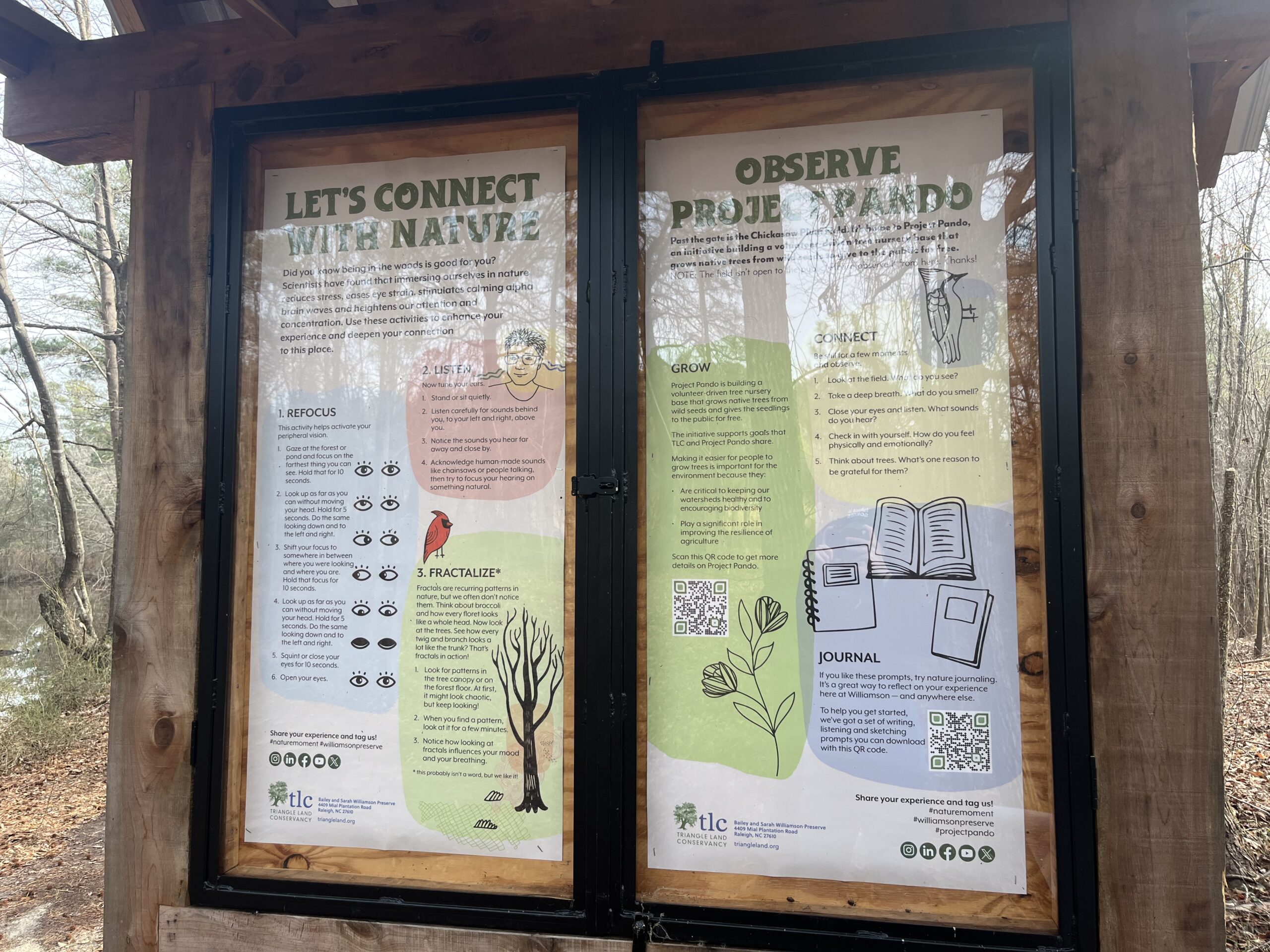
Sometimes, it helps to have a prompt to guide our thinking, discuss with our trail mates, or record in our nature journals. Here are some inspired by the new nature moment guide TLC installed on the Two Ponds Loop Trail at Williamson Preserve:
- Look at the canopy. Identify the recurring patterns (fractals) and interesting shapes revealed with the leaves gone. When you find a pattern, look at it for a few minutes. Notice how looking at fractals influences your mood and your breathing. What else do you notice about the tree’s “skeleton”?
- Breathe it in. Take a deep breath, hold it a beat, and then exhale slowly. Take a second breath. What do you smell? Take another and try to notice the elements that make up the smell – like dirt, leaf litter, evergreen, wet dog. Take one more deep breath. How do you feel physically and emotionally in this place?
- Listen closely. Stand or sit and bring your awareness to sounds behind you, to your left and right, and above you. Take in the sounds you hear far away and nearby. Acknowledge human-made sounds like chainsaws or talking. Then re-focus on something natural. If you have a bird ID app on your phone, this is a good time to use it.
- Give thanks. Consider all that surrounds you. What’s one reason to be grateful for nature in general, this particular place or a tree, plant or animal here? What’s one thing you can do to protect and preserve it?
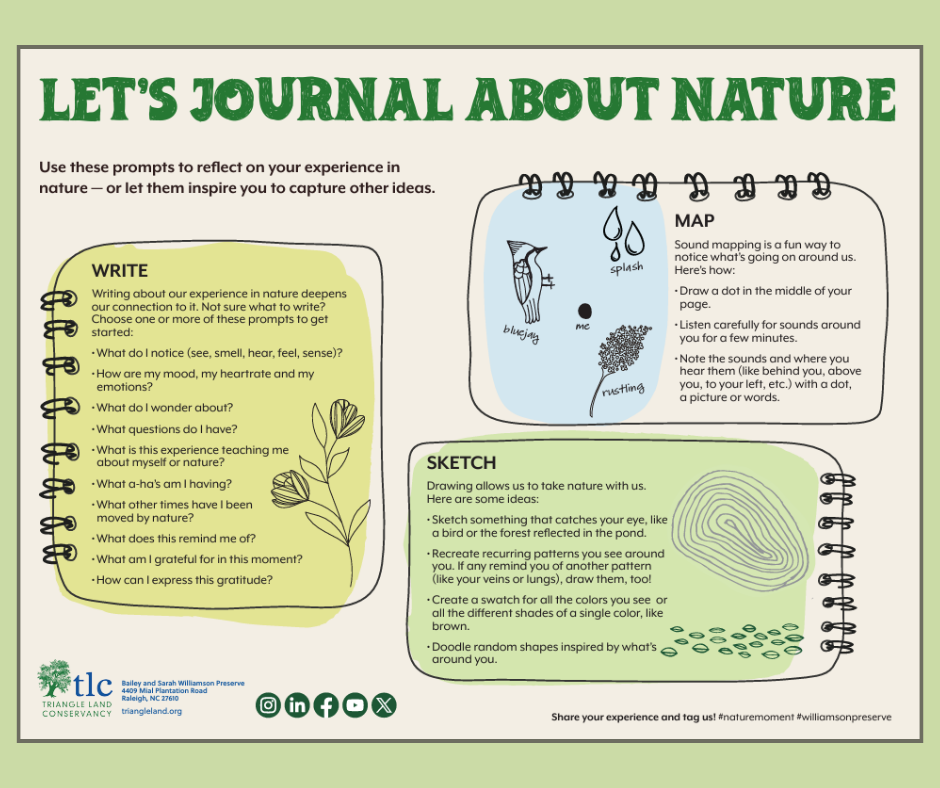
Want more prompts? Download or screenshot TLC’s nature journaling guide.
Observing the Winter Woods
When I’m out in the winter woods, I’m drawn to two of our native trees.
The American Beech is the tree that stubbornly holds onto its leaves all winter. They’re especially beautiful in the afternoon light, when the papery leaves almost glow, and on a gray day when the golden-tan color really pops. I also love the soft rustling when a breeze blows through.
The hollies’ (plural because we have a lot of different ones) red berries get most of the attention this time of year, but their leaves and bark are worthy of note too. I like to see how many different kinds of leaves I can find. That’s right, not every holly leaf is prickly. This is called heterophylly, and sassafras trees (among others) do it too. I’m also captivated by their bark. Most hollies have a lovely mottled pattern that I love to contemplate and photograph.
Whether you go on a walk in the woods on your own or join one of our hikes this winter, take a stop or two for observation. And if you take pictures for social media at one of our preserves, don’t forget to tag TLC and use #naturemoment.
Margot Lester is a TLC trail guide and certified interpretative guide who lives in Carrboro. She developed the Williamson nature moment kiosk as her final project for state environmental education certification.

