
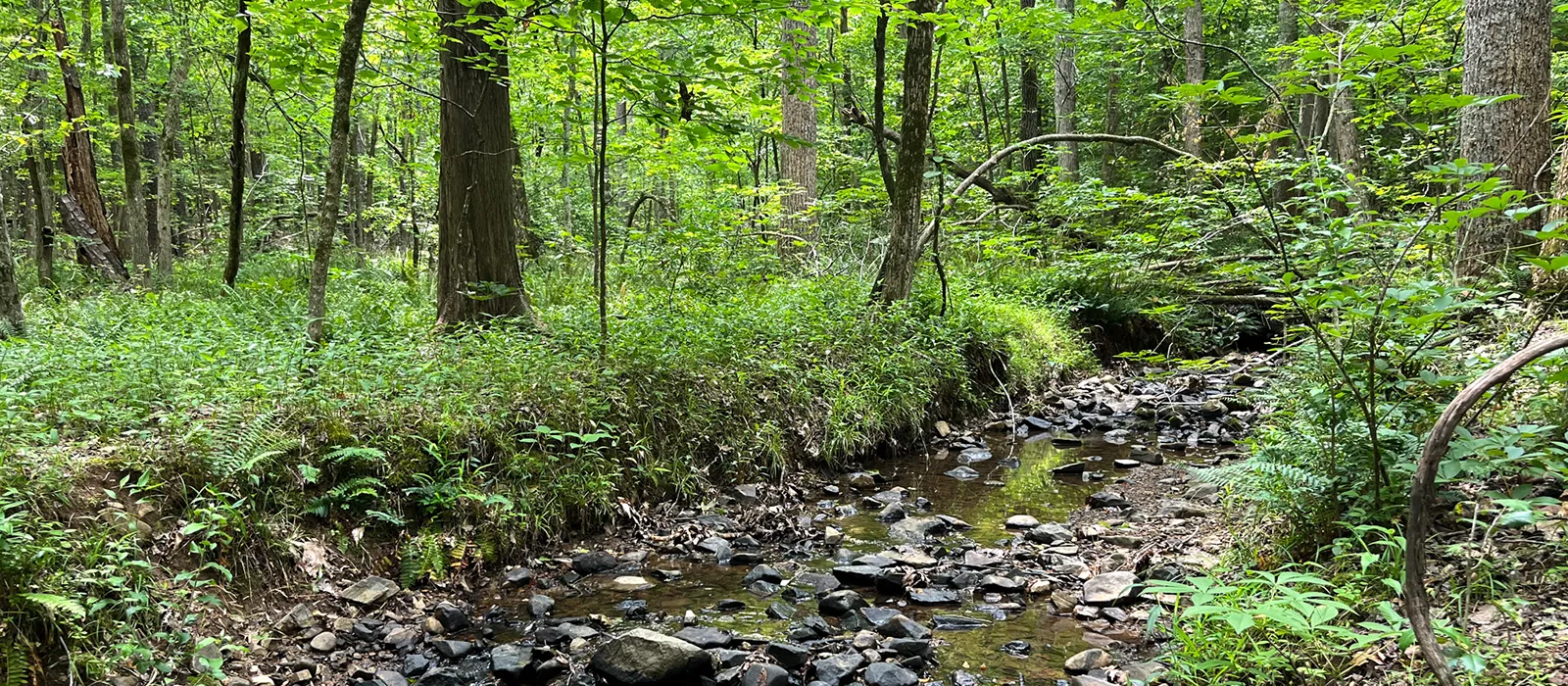
In June, TLC permanently conserved 248 acres of undeveloped, forested land located between Fearrington Village and Jordan Lake. This beautiful property contains wetlands, streams, and steep slopes that are unusual for the area and critical to the region.
The property directly abuts the B. Everett Jordan Dam and Lake, one of the largest sources of drinking water and recreation in the state, which is owned and operated by the U.S. Army Corps of Engineers. The parcel has been identified as the highest priority for conservation by the Eno-New Hope Wildlife Connectivity Plan and as a critical parcel to protect the Jordan Lake drinking water supply by the Jordan Lake One Water Plan. Over 7,500 feet of streams flow through this property directly into Jordan Lake, the drinking water source for the Towns of Cary, Apex, and other local communities.
This is TLC’s first acquisition of land directly abutting Jordan Lake’s protected lands in a decade, and its second largest single acquisition ever in Chatham County. Together with our partners, 46,768 acres are conserved around Jordan Lake in the midst of the expanding Triangle area. Jordan Lake houses the largest population of Bald Eagles in North Carolina making land acquisitions contiguous to the Lake a high priority for conservation organizations to not only protect water quality but also secure wildlife habitat and corridors.
TLC purchased the land from Fitch Creations, Inc., the developer of Fearrington Village, with funding from the North Carolina Land and Water Fund, The Arthur Carlsen Charitable Fund of the Triangle Community Foundation, several private donors, and a generous charitable contribution from Fitch Creations, Inc. TLC also acquired an access easement from Fitch Creations, Inc., connecting this landlocked property via an existing gravel road.
“Almost 20 years ago I acquired a parcel next to Fearrington Village from the Gaines family,” said Fitch Creations, Inc. owner and founder R.B. Fitch. “When TLC approached us a few years ago, we came to the conclusion it was a better fit for conservation. It’s gratifying to help permanently conserve such a lovely spot at Fearrington’s doorstep.”
In addition to protecting open space to secure clean drinking water and natural habitats, connecting people with nature is essential as TLC looks to balance our increasingly indoor, urban lives with the benefits and fun of being outside. When people have meaningful experiences outdoors their quality of life, health and social wellbeing improve, and in turn their communities become stronger and more sustainable. TLC’s core strategy for connecting people with nature is the activation of our preserves.
Now that the property has been conserved in perpetuity, TLC will begin the process of determining if it will become a public nature preserve, which includes a multi-year planning process considering the staff time and cost necessary to design, install trails, open, and maintain a public nature preserve. TLC has conserved over 23,000 acres across the region and operates 8 public preserves including White Pines Nature Preserve in southern Chatham County. TLC’s first public preserve, White Pines opened in 1987 on 137 acres with only 1.8 miles of trails. Today it has expanded to 285 acres and 5.8 miles of trails.

