By Cara Lewis, Senior Communications Manager

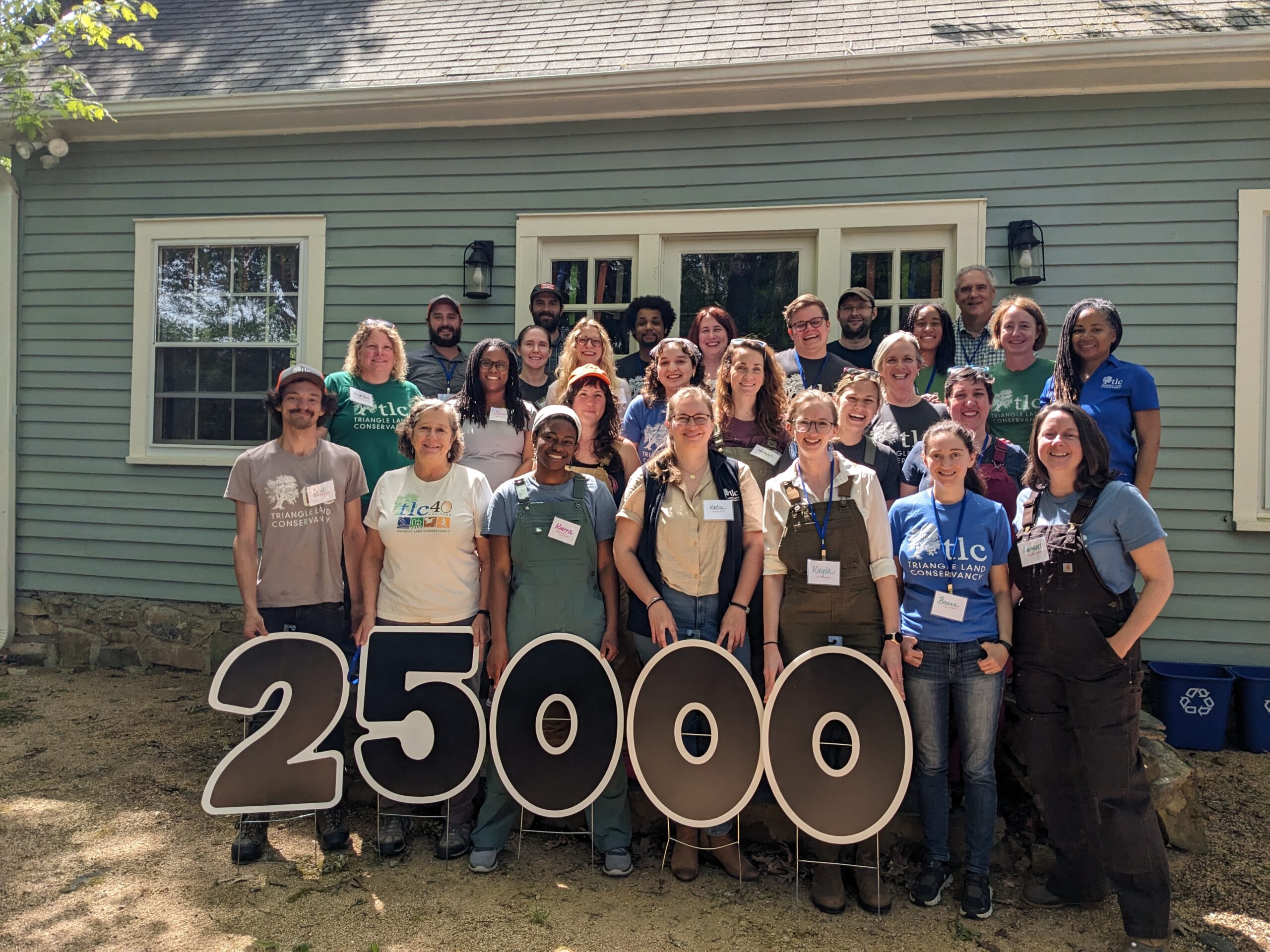
Triangle Land Conservancy (TLC) surpassed a strategic goal set in 2018 to permanently protect and steward 25,000 acres of land across the Triangle by 2025. As of April 1, 2024, TLC has conserved 25,035 acres.
“Thanks to willing landowners, the state of North Carolina, partnerships with local counties and municipalities, as well as the military, we have succeeded in doubling the pace of conservation in the past seven years,” said Sandy Sweitzer, TLC’s Executive Director.
“Building on decades of conservation work by many dedicated people, since 2018 TLC has worked to expanded our capacity and strengthened partnerships to carry out our mission to conserve and protect the wild and working lands throughout the Triangle. I am extremely proud of our accomplishments in reaching this milestone – and doing so a year early. But we must continue to conserve land, even as the region’s population grows.”
As North Carolina continues to become a top destination in the country for those seeking good jobs and a better quality of life, communities throughout the Triangle are experiencing rapid growth and development. Thanks to the NC Legislature, State agencies including the Land and Water Fund and Agricultural Development and Farmland Preservation Trust Fund, have increased support for land conservation. County commissioners are also prioritizing land protection in their budgets and long-range plans providing essential local funding for projects.
“TLC works closely with community partners, local municipalities, and counties,” said Sweitzer. “These partnerships are critical; together, we identify properties to protect, secure grant funding, and ultimately ‘close’ on a land protection project.”
Forty years of successful partnerships for strategic conservation
In 1984, TLC protected its first property, 32-acres in northeastern Wake County. Temple Flat Rock is now a state registered natural heritage site and home to 30 acres of farmland as well as the rare granitic rock outcrop.
Forty years later, Wake County and TLC celebrated one of our biggest farmland preservation projects in history when father and son, James and Matthew Bailey, placed 125 acres of their Wendell farm into the Wake Soil and Water Conservation District’s (WSWCD) Farmland Protection Program. TLC will hold and monitor the easement in perpetuity to ensure the land is protected.
“Because of this easement, these nearly 125 acres of fertile farmland and gorgeous forests will forever be protected from new development,” said Shinica Thomas, Chair, Wake County Board of Commissioners, at a dedication celebration earlier this year. “This agreement is a milestone for more than just Wake County. By investing over a million dollars of deferred agricultural tax funds, it represents the largest single-county dedication of farmland preservation funds in the whole state of North Carolina. In the past two years the County has dedicated close to $8 million for Farmland protection though this program.
Building on 40 years of conservation
“It’s been a big year for TLC, as we’ve are built on all the hard work and commitment to conservation of the past 40 years,” said Marlena Gutierrez Byrne, TLC Board Chair. “We could never have hit our goal of conserving 25,000 acres by 2025 without TLC’s many partners and generous donors. Surpassing this goal over a year early is just incredible!”
“For all of us who live here, in one of the fastest growing areas of the country, having open space, clean drinking water, and locally grown foods is something we cannot take for granted,” said Gutierrez Byrne. “I am so honored to play a small part in TLC’s mission to protect wild and working lands while we still can.”
TLC is increasing efforts to partner with landowners, state and local governments to ensure that everyone in the Triangle has access to green spaces, clean water, fresh air, land ownership opportunities, nutritious food, and more opportunities to connect with nature. In the last year alone, TLC and partners helped protect over 1300 acres valued at $25 million.
Partnering to protect land and water quality in Wake County
“I am thrilled to see TLC reach this important milestone,” said Will Summer, Executive Director for the N.C. Land and Water Fund. “Since our contribution to TLC’s work in the New Hope Creek corridor in our very first grant cycle in 1997, we have awarded over $32 million to TLC to protect land in the Triangle. I look forward to all the great things our partnership will continue to accomplish in the years to come.”
TLC has had a long partnership with Wake County and the City of Raleigh, to support land protection near Falls Lake. The three organizations worked together in January of 2024 to protect a vast wild area of northern Wake County that helps ensure critical water quality protection of the City of Raleigh’s main drinking water supply, Falls Lake.
“We were thrilled to partner with Triangle Land Conservancy and the City of Raleigh to protect this unique 320-acre property,” said Chris Snow, director of Wake County Parks, Recreation and Open Space. “In addition to nine headwater streams that flow directly to Fall’s Lake, this conserved tract has over five miles of stream as well as a portion of a designated natural heritage area. It also connects four properties previously conserved with funding by the Raleigh Watershed Protection Program and Wake County Open Space Bonds creating 800 acres of contiguous unfragmented open space adjacent to the lake.
“Since 2006, Raleigh has strongly supported land conservation projects as the best means to protect water quality through our Watershed Protection Program,” said Edward Buchan, Assistant Director for Raleigh Water. “Given the tremendous growth the Triangle area is experiencing, water supply watershed protection is more important than ever, and we are excited this property will be protected in perpetuity. We also deeply appreciate the partnerships with Wake County and Triangle Land Conservancy in helping protect these critical natural resources.”
In total this partnership has helped protect over 10,000 acres of land and 130 miles of stream in its 20-year history supporting clean drinking water for over 1 million people.
“The City of Raleigh is proud to support one of the most innovative and effective watershed protection programs in the Country over the past 20 years,” said Stormie Forte, At-Large Council Member for the City of Raleigh. “By partnering with TLC to protect land and water, we will be providing clean drinking water for Raleigh and all the communities we serve for generations in the future.”
Protecting farmland with the City of Durham and Orange County
Orange County’s Land Legacy Program recently worked with TLC to complete a conservation project on Terry Road in eastern Orange County, upstream from the City of Durham’s drinking water supply.
“By partnering with Triangle Land Conservancy on this conservation easement, which includes 35 acres of active farmland and 15 acres of forested lands, we are conserving critical aquatic habitat that is upstream from the City of Durham’s source of drinking water,” said Chris Hirni, Land Conservation Manager, Orange County Land Legacy Program. “We look forward to continuing to work with private and non-profit partners such as TLC, to protect important resource lands in Orange County.”
Working with Johnston County to preserve open space and farmland
Johnston County is ranked 19th out of all the counties in the country for potential farmland loss in the next 15 years. In the last year alone, the County has helped TLC protect over 300 acres of farmland and forests. In his 2024 State of the County Address to the Johnston County Board of Commissioners, Chair Butch Lawter cited land use as one of the six priorities for Johnston County.
“Farmland preservation is an integral component of Envision Johnston,” said Lawter. “We’ve stepped up in a big way by committing Present Use Value funds to preserve farmland through conservation easements and the Board continues to support Triangle Land Conservancy by approving funds to support projects in our annual budget. Last year the county dedicated $825,000 to preserve open space and farmland in Johnston County.”
Planning for future conservation in Lee County
With funding from US Fish and Wildlife and the Conservation Fund, TLC recently completed a conservation plan to recognize the immense value of the Rocky and Deep Rivers and develop strategies to protect their integrity in a changing landscape. The plan calls for protecting 10% of land within two miles of the rivers (7,600 acres) in 10 years, and 25% in 25 years (19,000 acres).
As part of the planning process, TLC conducted several stakeholder and outreach meetings over the past year to provide ongoing opportunities for community input. Lee County officials are working with TLC to support funding for conservation and several grant applications have been submitted to both the NC Land and Water Trust Fund and the NC Department of Agricultural & Consumer Services to protect priority land identified within the plan.
Connecting people to nature and conserving land in Chatham County
White Pines Nature Preserve in Chatham County was the second major land acquisition project for TLC in 1987 and the first public nature preserve. Located at the confluence of the Deep and Rocky Rivers this mountain-like sliver of the Piedmont provides a refuge for a curious collection of Mountain, Piedmont and Coastal Plain flora and fauna. Thanks to willing landowners, White Pines Nature Preserve, renowned for its isolated strand of white pines (Pinus strobus) now protects more than 270 acres.
In the past year, TLC has protected several properties in Chatham County including a donated conservation easement on a 38-acre family farm in 2023. Landowners in an established farming community in the Silk Hope region have ensured that it will remain as open space and farmland with rich soil quality and natural areas. Features of the property include an intermittent stream running through it into the Upper Cape Fear watershed, a hardwood forest, and a partially wooded pasture maintained for the benefit of rescue donkeys.

